
A Tarkari by Any Other Name?
The Case of the Venezuelan Curry

I have to admit to a deep love for MasterChef Australia. I’ve watched every single season, most of them more than once (my husband and I watched all the seasons until our daughter was old enough to appreciate them too, at which point we included her in our viewing sessions; then she began clamouring to see the older seasons too, so we trawled through YouTube etc and watched whatever we could find).
Anyhow: we were watching MasterChef Australia Season 14, and in one of the episodes, a contestant—Keyma Vasquez Montero, who is of Venezuelan origin—made a tarkari. The first time I heard Keyma announce that she was making a traditional Venezuelan dish called a tarkari, I wasn’t exceptionally interested, because I didn’t think there was any way Keyma’s tarkari would be akin to the tarkari I know. ‘Tarkari’ is a common enough word for a vegetable dish here in North India: not a specific dish, but just an umbrella term for vegetables. A term that’s applied to vegetables as such, as well as to the dish prepared from them. It could be dry, it could be a curry-like dish. It could be complex, with a dozen different ingredients; or it could be the very essence of simplicity, the sort of thing you throw together quickly when you don’t have time for anything else.
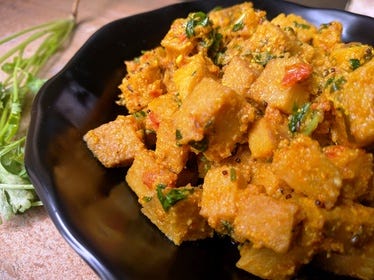
Of course I was a little amused that in Spanish-speaking Venezuela too they had something to eat that was called ‘tarkari’. Given that Keyma began by putting meat into her basket in the pantry, I guessed that the Venezuelan tarkari was something quite different from our tarkari: not a spicy vegetable preparation.
Imagine my surprise, then, when Keyma began to toast off a bunch of spices: exactly the sort of stuff that would go into a masala here: mustard seeds, cumin seeds, coriander seeds, fenugreek seeds… She marinated the meat, she fried off onions, she used pretty much the same sort of techniques and ingredients a cook in the Indian subcontinent would use to make a curry.
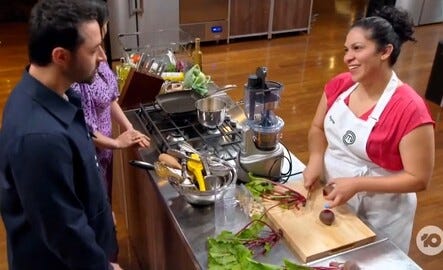
It looked like a curry, and from what people said about it, it was a curry.
I couldn’t figure it out. The way Keyma spoke of it, it was a traditional dish, not an ‘acquired’ novelty, perhaps, that she had learnt to cook from an Indian friend. But it was quite definitely an Indian-style ‘curry’, and of course it was called tarkari (even if it had no veggies in it). But Venezuela had no Indian diaspora, and the Spanish (unlike the British) had had no colonies from which they might have picked up the art of making curries and passed it on to their other colonies here in South America.
I found the answer to that riddle in an unexpected way. Later that year, I happened to meet linguist Peggy Mohan (who is of Trinidadian descent) at a literary festival. I mentioned the conundrum of the Venezuelan tarkari to Peggy, and she told me that Venezuela is separated from Trinidad by only a few kilometres: you can actually see the other country across the water that lies between them. (Yes. I should have looked at a map in the first place. Just goes to show).
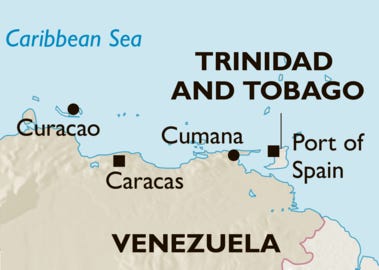
This, of course, makes things a lot clearer. Trinidad has a major concentration of Indians, many of them tracing their ancestry to Bihar, where a vegetable dish would be called tarkari. In Trinidad (as also in nearby Guyana), a vegetable dish—called tarkari or talkari—may be made out of umpteen types of vegetables, or fruit deemed vegetable, such as raw mango, ridge gourd, pumpkin, and potato. I found that some Trinidadians add vegetables to their meat curries as well (potatoes seem to be a hot favourite, as they are in India), but ‘tarkari’ seems to be a word applied primarily only to all-veg preparations, not meat-plus-veg.
Somewhere in the course of the transfer of this dish from Trinidad to Venezuela, it seems, the nature of the dish changed somewhat. The spices and the method of cooking remained pretty much the same as those of Trinidadian curries (minus the typical ‘green seasoning’ pesto-like mix of herbs and aromats that is a staple of Trinidad food). The name remained the same, down to the ‘talkari’ variation, but the vegetables fell off the radar and meat took its place. A distinctly non-Caribbean (but very likely Spanish-influenced?) addition was made to the ingredients: wine, used to deglaze and of course add a unique flavour all its own.
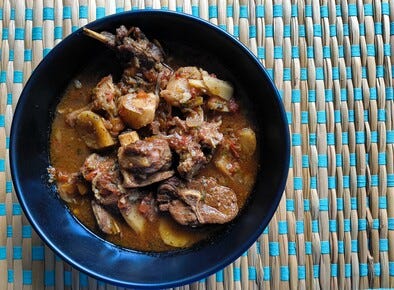
And hey presto, a curry in a place you wouldn’t expect. It tastes fabulous, too. Keyma’s recipe can be found here as a reel on her Instagram account. This one is for a kangaroo version of the dish, but it is pretty much the same as her original goat meat tarkari recipe, the Tarkarí de Chivo. If you’d rather a text-only version, her goat tarkari recipe is to be found here.
Absolutely fascinating! Migrations of people, cultures, cuisines, so many influences everywhere!
Who would have thought!